VIBRATION TEST

TURKAK Accredited Testing and Verification
STEST is accredited by the Turkish Accreditation Institution (TURKAK) and carries out its testing and verification activities in an independent, competent, and impartial manner in compliance with national and international standards.
Vibration Test
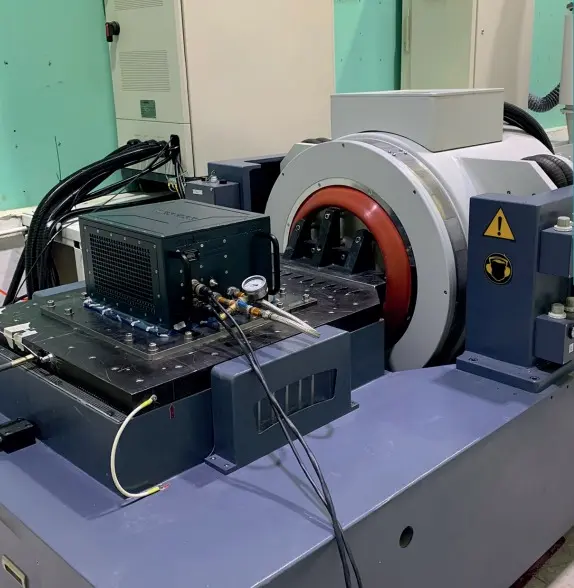
The Vibration Test is performed to verify the structural integrity of the test item under the dynamic loads it is exposed to in real operating conditions and to identify potential design weaknesses. Testing is conducted under laboratory conditions using endurance requirements and load profiles defined based on applicable military/civil standards or the closest representation of the product’s actual service environment.
Objective Goal
- Verify structural integrity under dynamic loads and identify potential design weak points.
- Evaluate whether the product can withstand the intended application severity without degradation or excessive wear.
- Provide engineering verification data to improve reliability and optimize performance.
Test Scope Scope
- Laboratory verification using military/civil standards or vibration profiles that best represent real service conditions.
- Controlled simulation of transportation-induced vibrations and evaluation of potential damage mechanisms.
- Identification of risks such as loosening, wear, and component damage (fasteners, mounts, component integrity).
Technical Implementation Process
- Vibration tests are performed in a laboratory environment using data acquisition/processing systems, control hardware, sensors, and shakers; a thermal chamber may be used when required.
- Transportation vibration is simulated under controlled conditions to verify risks of excessive wear, loosening, and component damage.
- For production/acceptance processes, accumulated damage prior to delivery can be assessed and field-life verification can be supported following environmental vibration testing.
- When the manufacturing method, process, or assembly location changes, re-testing and re-evaluation are recommended to address potential changes in the environmental vibration exposure.
Application Areas Use
- Equipment operating in defense and aerospace applications
- Systems and components designed for rough and demanding field conditions
- Products exposed to vibration during transportation and logistics processes (including automotive/industrial equipment)
At STEST, we perform Vibration tests within the scope of MIL-STD-810 and RTCA DO-160G using our laboratory infrastructure, and we provide detailed reporting for structural endurance, loosening/wear risks, and functional compliance.
REQUEST A TEST APPOINTMENT